F-150 Lightning: Towing & Work Truck Realities
The most powerful F-150 ever made has a surprising Achilles' heel.
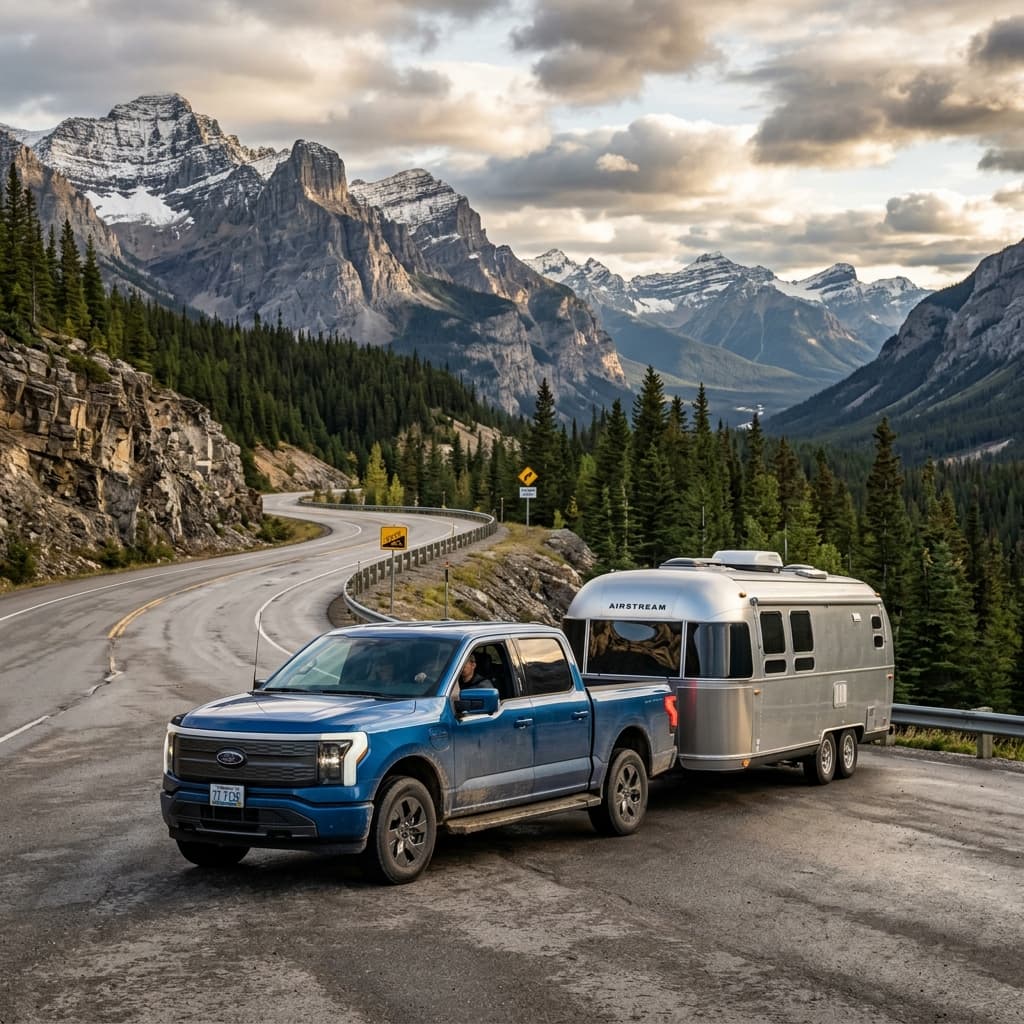
For decades, the Ford F-150 has been the backbone of American labor. When the Lightning was announced, it promised to bring that utility into the electric age. In many ways, it succeeded brilliantly. It is faster than a Raptor, has a "Mega Power Frunk" that can hold 400 lbs of gear, and can power your entire house for three days. But there is one area where the laws of physics are unforgiving: **heavy-duty towing**.
The Power of Instant Torque
Towing with a Lightning is, in a word, effortless. A traditional gas or diesel truck has to downshift, rev high, and scream its way up a mountain grade. The Lightning just *goes*. With 775 lb-ft of torque available from zero RPM, pulling a 7,000-lb trailer feels like pulling nothing at all. The stability provided by the low-mounted battery pack also makes for a significantly more planted feel than a traditional high-center-of-gravity pickup.
The Aerodynamic Penalty
Here is the reality: gasoline contains an incredible amount of energy compared to a battery. A gallon of gas has roughly 33.7 kWh of energy. A Lightning's Extended Range battery has 131 kWh—the equivalent of about **4 gallons of gas**. When you hook up a massive, un-aerodynamic box trailer, the energy required to push that "brick" through the air at 70 mph increases exponentially. In our testing, towing a standard travel trailer **slashed the range by 45% to 55%**.
On a full charge, an Extended Range Lightning (normally 320 miles) becomes a **130–150 mile truck** when towing. Factor in the fact that you rarely want to arrive at a charger with 0%, and your practical "leg" between chargers becomes just 100 miles. For many long-haul towers, this is a non-starter.
The 'Sweet Spot' for the Lightning
The Lightning is the perfect truck for 90% of pickup owners who use their truck for local work, "Home Depot runs," and towing boats 30 miles to the local lake. For the professional "hot-shot" driver or someone pulling a camper 500 miles every weekend, diesel remains king for now.
Charging While Hooked Up
Most public fast chargers were designed like parking spots, not gas stations. This means you have to **unhook your trailer** to pull into most charging spots. This adds 15–20 minutes to every stop. Tesla is starting to add "pull-through" spots at Superchargers, but until this becomes the standard at Electrify America and others, towing an EV across state lines is a test of patience.
Pro Power Onboard
The standout feature of the Lightning is its ability to export up to **9.6kW of power**. You can run entire job sites—circular saws, compressors, and lights—directly from the truck's bed outlets. No noisy generators, no gas cans. For contractors, this feature alone often pays for the truck in efficiency gains.
Final Verdict
The F-150 Lightning is a phenomenal electric vehicle and a mediocre long-distance towing machine. It is a technological marvel that serves the vast majority of truck needs while saving thousands in fuel costs, but it requires a change in mindset for those who live life on the hitch.
Use the article, then make a decision
Spoiler: It's cheaper than gas, but the math isn't as simple as everyone tells you. We break down home vs. public charging costs in 2024.
The ultimate showdown between pure electric commitment and the convenience of a gasoline backup. Which technology fits your 2024 lifestyle?
Debunking the 'battery death' myth. We look at 10 years of data from over 20,000 electric vehicles to see how they age.
Stop reading generic advice.
Run your exact commute and energy rates through our calculators.